The world's only self-pitching propeller
Autoprop finds the right pitch. Every second. Automatically.
The propeller for cruising and motor-sailing, proven across 11,353+ documented fitments: fewer revs, less fuel, real reverse control and feathered low drag under sail — with nothing to adjust, ever.
What changes
Eight things owners notice after the swap
Cut cruising revs by 300–400 RPM
The blades take the optimum pitch for the conditions, loading the engine properly instead of over-revving. Same speed, less noise, less wear — independently measured at 6 kn on 2,100 rpm vs 2,500 for a standard prop.
Save up to 20% on fuel
The typical saving over a fixed-pitch propeller at cruise. The French Voiles trial ranked Autoprop first for consumption at 6 knots; some documented owners report more than 20%.
Motor-sail like the Mediterranean pros
As apparent wind builds, a fixed prop's pitch becomes wrong. Autoprop re-pitches continuously — the single biggest benefit owners report on long light-air passages.
Stop and steer like you never could
Blades swing through 180°, presenting the same efficient face astern as ahead. Full reverse bite, less prop walk, controlled marina stops.
Sail up to a knot faster
Feathered, drag falls by up to 85% against a fixed three-blade — even more with the two-blade version — the difference between towing a bucket and not.
No pitch adjustment. Ever.
There is nothing to set, tune or re-pitch at haul-out — unlike adjustable feathering props. The physics does the adjusting, every rotation.
Punch weather like dropping a gear
Into wind and sea, the blades sense the extra load and fine their pitch, letting the engine reach full revs and full power. A fixed prop is over-pitched in exactly those moments — choking the engine when you need it most.
Full power at zero boat speed
The same self-fining behaviour means full engine power is available at very low speed — towing another boat, kedging off, or clawing away from a lee shore, where a fixed pitch can't let the engine spin up.
The measured record
Four charts, every number sourced
Independent trials and documented boats, plotted as published — each chart carries its measurement badge and its data table.
Speed at matched revs — four feathering props, same boat
Measured| Propeller | @1,500 rpm | @2,200 rpm |
|---|---|---|
| Feathering X | 3.85 kn | 5.5 kn |
| Feathering Y | 3.75 kn | 5.35 kn |
| Feathering Z | 4.2 kn | 5.75 kn |
| Autoprop | 5.1 kn | 6.65 kn |
Fuel burn at 6 knots — same boat, same day
Measured| Propeller | Fuel @6 kn |
|---|---|
| Feathering X | 2.20 L/h |
| Feathering Z | 2.03 L/h |
| Feathering Y | 2.00 L/h |
| Autoprop | 1.40 L/h |
Same speed, fewer revs — three documented boats
MeasuredBronze bar spans the revs saved: fixed-prop rpm (grey) down to Autoprop rpm (bronze) at the same boat speed — the 300–400 rpm rule of thumb, case by case.
| Boat | Speed | Fixed prop | Autoprop |
|---|---|---|---|
| YM test boat | 6.0 kn | 2500 rpm | 2100 rpm |
| Bavaria 38 | 5.5 kn | 2375 rpm | 1800 rpm |
| 21 ft motor yacht | 6.0 kn | 1500 rpm | 1250 rpm |
Crash stop from 6 knots — seconds to stationary
Measured| Propeller type | Seconds |
|---|---|
| Autoprop | 7.0 s |
| Fixed 3-blade | 9.5 s |
| Folding | 10.0 s |
| Conv. feathering | 13.0 s |
The real thing
Cast, machined, balanced — then photographed
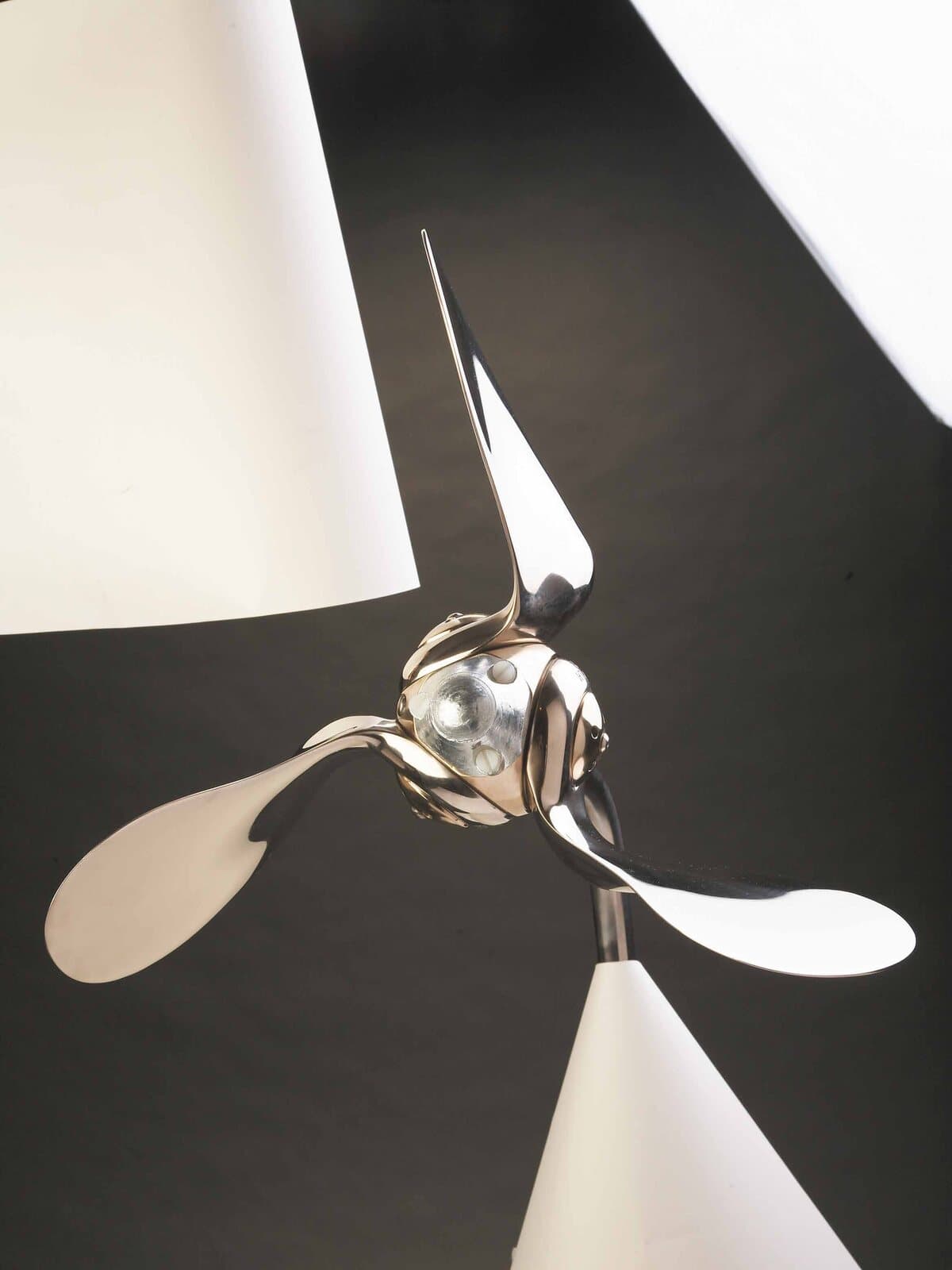
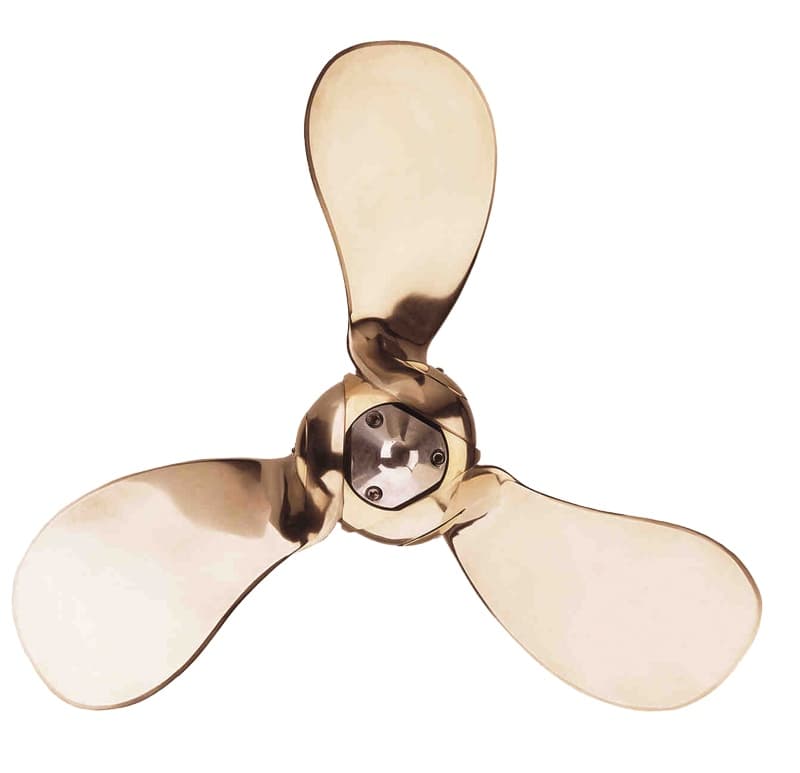
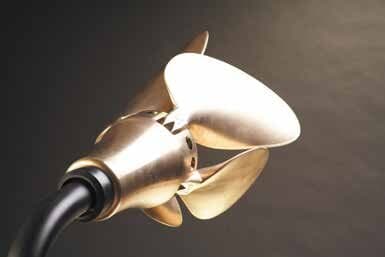
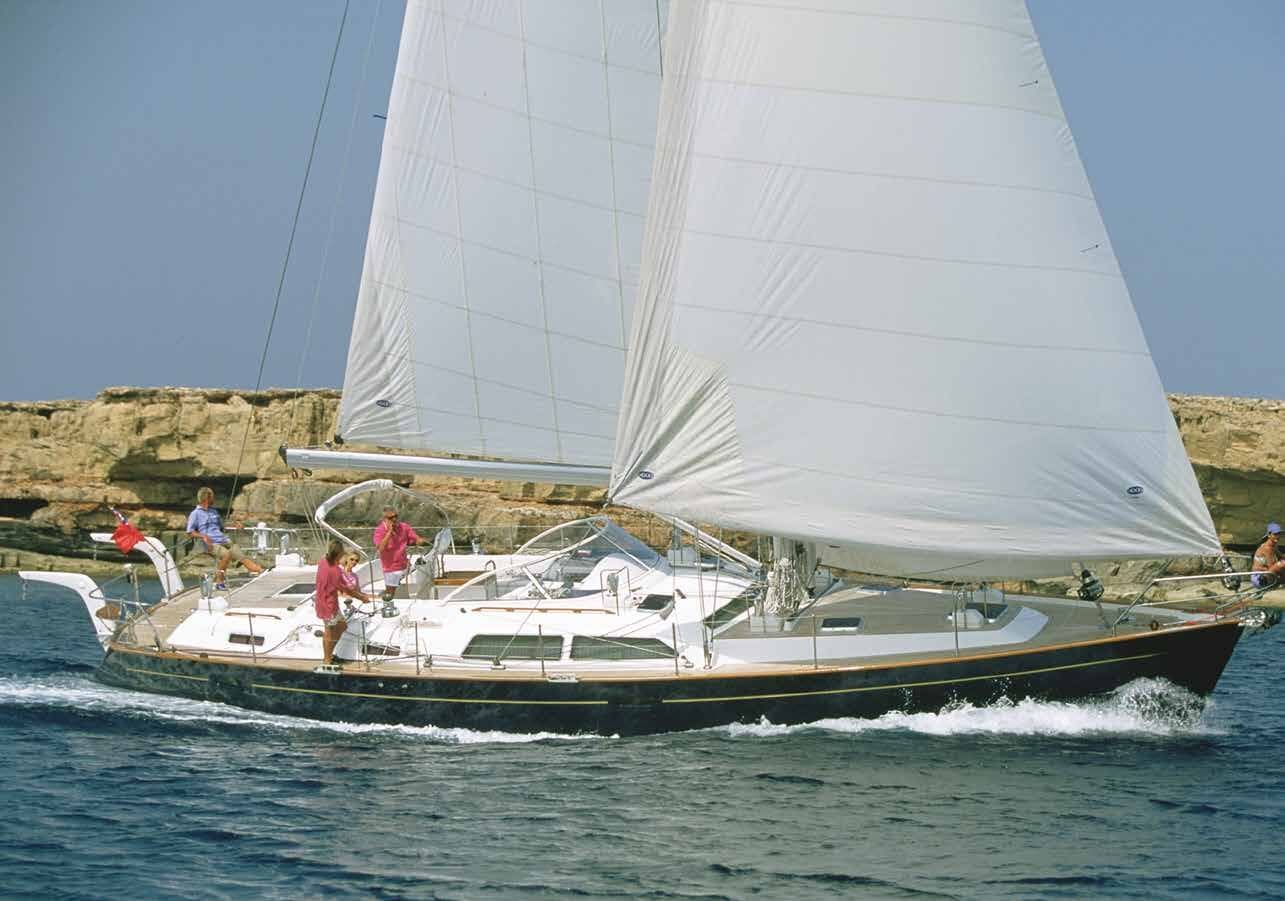
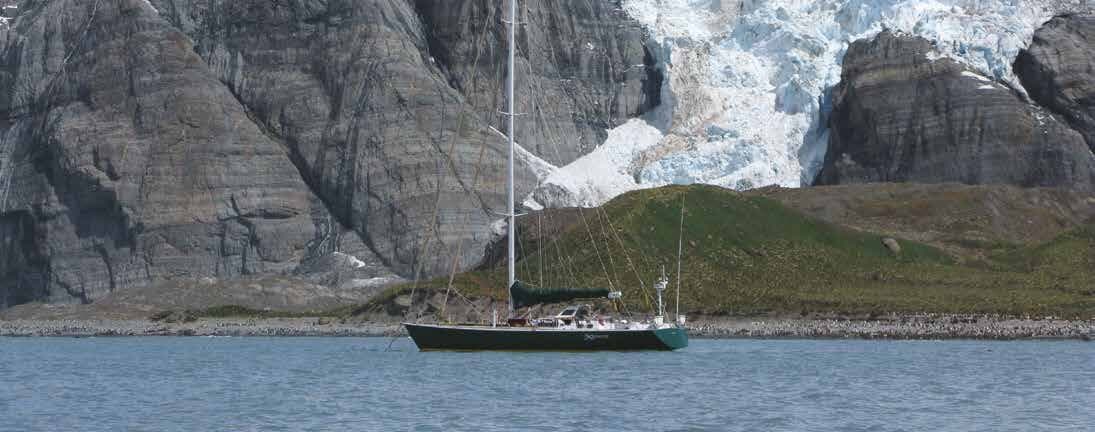
From the Bruntons programme's own files: the propeller in bronze, feathered and driving, and the boats that wear it.
The film
Watch it find its pitch.
Two minutes of the mechanism doing its thing — feathering under sail, re-pitching under power, swinging through 180° for reverse. Then scroll on and pull the drawing apart yourself.
- The blades weathervaning as the shaft stops
- Pitch coarsening as the throttle opens
- The 180° swing that gives full thrust astern
The technical drawing
How it works — no brochure required
The mechanism, drawn from the engineering: switch working modes to watch the blade section re-pitch, and click the numbered parts for what each one does.
Interactive technical drawing · BA-AP-01
Autoprop H-series — the self-pitching mechanism
Polished ball hub
The signature sphere carries the three blade stations. Cast in bronze, machined and balanced — the geometry that lets each blade pivot without gears or springs.
How it works
Blades that weathervane to the load
Each Autoprop blade pivots on its own bearing race, free to rotate through 360°. The blade's centre of pressure is offset from its pivot axis, so the water flow itself twists the blade until thrust and torque balance — the definition of the right pitch for that moment.
Throttle up and the blades coarsen. Motor-sail and they fine off, keeping the engine loaded instead of screaming. Put it astern and the blades swing fully around, presenting the same leading edge and camber in reverse — which is why the reverse bite surprises everyone the first time.
Stop the shaft under sail and the blades feather edge-on to the flow, cutting drag to a fraction of a fixed propeller's.
Data table & assumptions
| Engine RPM | Fixed prop (kn) | Autoprop (kn) |
|---|---|---|
| 1000 | 3.0 | 3.4 |
| 1500 | 4.3 | 4.9 |
| 2000 | 5.5 | 6.2 |
| 2500 | 6.6 | 7.5 |
| 3000 | 7.7 | 7.7 |
Indicative curves modelled from documented fitments and the pattern reported in independent testing (6 kn at ~2,100 rpm with Autoprop vs ~2,500 rpm with a standard fixed propeller). Assumes a displacement hull of ~10.5 m waterline; your boat's real numbers are confirmed by a Bruntons engineer before we supply anything.
The range
Four series, 330–750 mm
Series is set by diameter and shaft size; exact diameter is set by your engine power, max RPM and gearbox ratio — that's the sizing we verify on every order.
| Series | Blades | Diameters | Shafts | Engines | |
|---|---|---|---|---|---|
| H5 | 3 | 380–510 mm (15–20″) | 20–35 mm (⅞–1½″) | to 100 hp | Details → |
| H6 · H9 · H62 | 3 | 470–900 mm (19–35″) | 35–75 mm (1½–3″) | to 350 hp | Details → |
| H20 | 2 | 330–430 mm (13–17″) | shafts & saildrives | to 50 hp | Details → |
| APS saildrive | 3 | 330–510 mm (13–20″) | Volvo · Bukh · Yanmar-approved | per drive | Details → |
2021 brochure figures. APS carries a rubber insert to keep shock loads out of the saildrive leg, a double-nut locking feature and an anode as standard — and is officially approved by Yanmar. Above 350 hp, or anything unusual, moves to custom engineering. Every wearing part is replaceable, unlike most competitors' — a Bruntons propeller is a lifetime asset, not a consumable.
The press file
Six magazines tested it. One conclusion.
Every quote below is from a named publication's own test, reproduced from the Bruntons press file — plus the man who raced the wrong way around the world.
“Our tests show the Autoprop achieved 6 knots at 2100 rpm compared to 2500 rpm for our standard prop and most of the others on test.”
“The qualities of the Autoprop make it perfect for long distance cruising. It ranked first for consumption at cruising speed.”
“At RPMs up to 2000 no other propeller can beat the Autoprop, it clearly gave more speed.”
“A phenomenon across all speeds is the Autoprop. An excessive amount of engine power is always available, because this propeller comes up with optimum efficiencies at any speed.”
“Certainly one of the most interesting propellers in our survey. It demonstrated good speeds under all conditions.”
“I can highly recommend Autoprop propellers to all sail boat owners who want the very best performance under power and sail.”
“Fuel use down more than 30% on a 75 hp Yanmar for my usage pattern — drag cut by up to 95%, and the response astern is immediate and symmetric.”
How far 10 litres takes you at 6 knots
Measured| Propeller | Distance on 10 L |
|---|---|
| Autoprop | 42.9 nm |
| Feathering Y | 30.0 nm |
| Feathering Z | 29.6 nm |
| Feathering X | 27.3 nm |
Documented fitments
Boats we've documented with Autoprop
A sample from the fitment database — open your boat's page for engines, ratios and sizes.
The honest bit
When Autoprop isn't the answer
- You race, and sail 80–90%+ of the time — a folded Varifold has even less drag than a feathered Autoprop. Consider Varifold.
- Heavily turbulent flow behind a massive deadwood or full traditional keel disturbs the self-pitching action — we'll tell you if your boat is in this category.
- A fouled prop is a wrong-pitched prop — like any precision low-drag propeller it wants a clean bottom and working anodes.
Questions owners ask
How does Autoprop set its own pitch?
Each blade pivots freely on its own bearing and is shaped so the balance of hydrodynamic and centrifugal forces rotates it to the pitch that matches the load — continuously, without springs, gears or adjustment. Motoring into a headwind it takes a coarser bite; motor-sailing it fines off to keep the engine loaded correctly.
Will it fit my saildrive?
Yes — the APS versions fit all leading saildrives including Volvo Penta and Bukh, and are officially approved by Yanmar. A rubber insert isolates shock loads from the leg, a double-nut lock secures the propeller, and an anode is fitted as standard. Around a third of the fitments in our database are saildrive installations.
What sizes does Autoprop come in?
Four series cover 330 mm to 750 mm: H20 (2-blade) and H5 (3-blade) for shafts from 7/8" to 1½", H6 for 1¼"–1¾" shafts, and H9 for 1¾"–2½" shafts, for engines up to roughly 350 hp. Larger and custom applications are engineered case by case.
Is there anything Autoprop doesn't suit?
Honestly, yes. It dislikes heavily turbulent water flow — for example immediately behind a very heavy deadwood or full keel — and like any low-drag prop it rewards a clean, unfouled blade. If you race and sail more than ~80–90% of the time, a folding Varifold's near-zero drag may serve you better. The Builder screens for all of this.
How is it serviced?
Routine care is a clean (ball-bearing models) or a clean and grease (roller-bearing models) whenever the boat is lifted. Unlike most rivals, every wearing part is replaceable — so the propeller is a lifetime asset, not a consumable. Our Queenscliff workshop handles the lot: strip-down, re-balance, bearing upgrades and refurbishment, with national shipping. Factory re-pitching and the latest needle-bearing hub upgrades run through Bruntons UK.
How hard is it to fit?
The Autoprop arrives fully assembled and a single nut secures it to the shaft — most fits are done in a haul-out without touching the engine. A dedicated Autoprop puller makes removal just as simple. We fit at Queenscliff or talk your yard through it anywhere in Australia.
Is Autoprop right for your boat?
Run the Builder — it checks your boat against the fitment database, screens the risk factors, and an engineer verifies the size before anything is supplied.